From a small town in Southern California to service work, public higher education, and an independent creative life: the experiences behind Ethan Avila’s campaign.
A life in milestones.
Choose a moment to explore Ethan’s story.
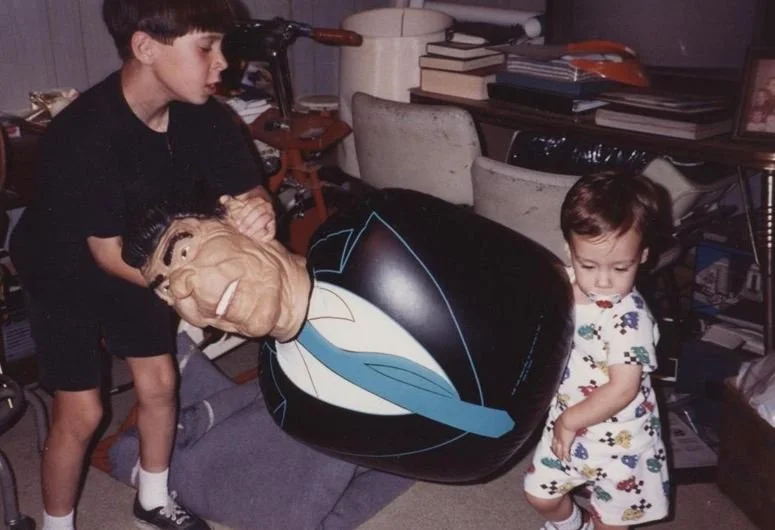
Ethan during his toddler years with a Reagan inflatable
Born in SoCal
Born in Southern California
Born in Southern California, Ethan grew up in a small town and a middle-class family. Those roots are the starting point of his story.
Ethan’s family lived in an apartment when he was born. In the early ’90s, his parents bought their first house: a single-story home in Southern California. His memories of growing up there are specific and familiar: the curved street outside, the speed he could build on a skateboard, and elementary school friends who lived nearby.
That first home is part of the background to his concern about housing today. His own experience provides a starting point; the policy still needs evidence about the different costs and circumstances other households face.
He grew up in a small town and a middle-class family. His adult life has included searching for stable work, pursuing an education, and building creative projects without a large financial cushion.
He wants to bring that perspective to the presidency, with a focus on whether working people can afford a home, receive healthcare, and build a more secure future.
THE CREATOR
Building something from nothing.
As a teenager, Ethan was especially into classic rock and collected CDs. At about fifteen, he got his first guitar: a red Fender Stratocaster. By sixteen or seventeen, he also had a MicroKorg synthesizer.
A listener before a label.
His musical influences include Gorillaz, Gnarls Barkley, The Beatles, Led Zeppelin, Michael Jackson, Nirvana, Vampire Weekend, MGMT, and early Arcade Fire.
From making music to releasing it.
In his late teens and early twenties, he began making music, collaborating, and producing. He created Avila Records during that period because he loved the range of genres and artists he listened to. He sees music as a big part of America.
Ethan writes and produces his own songs and built the label around his original work. Creating and releasing music has required sustained effort beyond the first idea, and informs his interest in giving more people the time and resources to build something of their own.
His website also brings together his artwork, writing, videos, games, and apps.
Ethan attended a local community college full time, made the honor roll, and earned an Associate of Arts and an Associate of Sciences. He completed all of his general education requirements there before transferring to a Cal State university, where he earned a Bachelor of Arts. He earned all three degrees during his twenties.
Interests beyond a degree.
U.S. history interested him enough to research it in his free time, beyond the work required for a class. He also took an acting class at community college and a law class at university. Those interests sit alongside the general education he completed before transferring: his education included exploring different subjects as well as working toward the next qualification.
Completing the transfer requirements and continuing his interests outside formal assignments are parts of that educational path. His policy proposals still need specialist advice and public scrutiny.
His route through public higher education informs his support for affordable college and practical preparation for adult life, including taxes, debt, employment, and buying a home.
THE WORKER
From the grill to office work.
Five years in service work.
During the Great Recession, Ethan struggled to find work while studying full time. His first long-term paid job was at McDonald’s, where he started on the grill as a Crew Member. Over five years, he learned the different positions and became a Crew Trainer, training new employees on every station.
One shift remains especially vivid: the restaurant’s air conditioning had gone out during summer, and he was working the grill at the hottest part of the day. His concern about working conditions and the cost of living comes from experiences like that as well as the jobs that followed.
A new career as the pandemic began.
He got his first office job at a small printer company just before the pandemic shutdowns and soon found himself working from home. There, he helped the company reach Best Seller status on an online marketplace.
Different industries, an ongoing working life.
He later worked for a food delivery company, as a Customer Service Representative for a copper company, and as a case manager at another company. Those roles involved helping people, learning new systems, and adapting to different workplaces.
HEALTHCARE, FIRSTHAND
An experience that stayed with him.
Ethan lived much of his first two decades in pain. Numerous doctors misdiagnosed his two hernias as hydroceles and spermatoceles. Years passed before a doctor correctly identified two incarcerated hernias, a potentially life-threatening condition if left untreated.
The diagnosis and the bill.
The surgery cost thousands of dollars. Both the delay in obtaining the right diagnosis and the cost of treatment shaped his belief that healthcare needs substantial reform.
For Ethan, coverage must lead to timely appointments, careful diagnosis, qualified clinicians, and treatment people can afford. His policy page sets out the proposed coverage, workforce, financing, and transition approach.
From registering to vote to putting forward his own ideas.
Ethan registered to vote in the 2010s. His decision to run came from watching recent presidents and believing he could offer a better direction.
He describes himself as “a nobody from the middle class.” He is putting himself forward from that background, rather than presenting an established political career as the reason to support him. The practical question for voters is what he proposes to do with the responsibility: which problems he would address, what authority he would need, and how he would respond when a plan runs into difficulty.
The Real Deal and First 100 Days pages are intended to make that judgment possible. They distinguish goals from delivery, identify decisions that remain open, and give readers a basis for asking follow-up questions. His biography explains the perspective he brings; the policy pages are where that perspective must be tested against costs, evidence, and implementation.
Why the middle class is central.
“The middle class is severely struggling,” Ethan says. He wants to bring America First together with people and workers’ rights, connecting household security with economic strength, technological progress, and military readiness.
He calls his economic approach Ethanomics and its broader program the Real Deal. His stated priorities include universal healthcare for eligible American-born citizens, affordable housing, and full federal marijuana legalization.
He supports equal dignity across races, creeds, ethnicities, and communities, including LGBT+ rights, women’s equality, and reproductive healthcare access.
JUDGMENT, LEADERSHIP & ACCOUNTABILITY
Frequently asked questions.
Questions about my experience, judgment, and approach to the presidency. Select a question to read the answer. For the full policy program, visit The Real Deal.
What convinced you to run for president?
Watching recent presidents, I believed I could offer a better direction. I come to that decision as someone from the middle class, with experience in service work, office jobs, public higher education, and trying to obtain necessary healthcare. I want those everyday concerns to carry more weight in national decisions. Running means putting my own ideas forward and accepting that voters should examine them closely.
What do recent presidents miss about middle-class life?
The middle class is severely struggling. A job title or a degree does not show whether a household can afford rent, obtain treatment, or build savings. I want national progress judged through those practical pressures, including whether wages keep up with the cost of a stable life. The working-life section above explains the experience behind that concern.
Why should voters trust someone without elected experience?
I am asking voters to examine my judgment, proposals, and willingness to be accountable. My working background gives me a perspective worth bringing to the discussion, but it does not give me every answer or replace the expertise needed to govern. I would need capable advisers, experienced public servants, and cooperation with Congress. Trust should be earned through clear explanations, realistic commitments, and results that people can check.
What experience demonstrates your ability to take responsibility?
At McDonald’s, I progressed from Crew Member to Crew Trainer and trained new employees on every position. That gave me responsibility for helping other people learn the work, alongside doing it myself. My later jobs required learning new systems and taking on different responsibilities. Those are practical experiences I bring with me. They are a foundation for explaining how I work, rather than a claim that running a workplace and running a country are the same task.
The approach I would bring to a larger responsibility is to understand the problem before promising an answer, listen to the people doing the work, make ownership clear, and check whether the result actually improves things. If someone needs help, a leader should make it possible to raise the problem early. If a decision fails, the response should be to explain it and correct it rather than leave other people to absorb the consequences.
In government, that approach would require qualified advisers, experienced public servants, lawful authority, and evidence that can be challenged. I would want the person responsible for an action, the next decision, and the result to be clear. My working background is the perspective I bring to that responsibility; it is not a substitute for the expertise needed to run an administration.
How have service and office jobs shaped your view of workers?
I remember working the grill during the hottest part of a summer day when the air conditioning had gone out. I also remember beginning my first office job just before the pandemic and then working from home. Different jobs put different demands on people. My concern is that employees should have safe conditions, fair treatment, useful training, and a realistic chance to move forward. A stronger economy should improve the lives of the people doing the work.
What did your healthcare experience teach you?
The experience described above made diagnosis, timely treatment, and affordability connected priorities for me. My proposal is national coverage for American-born citizens, including citizens born on U.S. military bases abroad, with no patient charges for covered care. Staffing, provider payments, financing, and the transition still need detailed legislation and legal review. Enrollment alone would not demonstrate success if patients could not obtain care.
What did public higher education teach you about opportunity?
My community-college-to-university route showed me why there should be more than one affordable path forward. I want education to support useful skills and prepare people for decisions involving work, taxes, debt, and housing. The test is not simply how many credentials someone earns, but whether learning helps them pursue opportunities afterward.
What does America First mean to you?
It means making the well-being of Americans a central test of national decisions: whether people can afford a home, receive healthcare, earn a living, and build a future. It also includes a strong economy, technological progress, and national security. I want to bring that national focus together with workers’ rights and respect for people’s dignity. The phrase should be explained through specific proposals and their effects, rather than left as a slogan.
Which priority would you advance first if Congress would move only one?
If Congress would advance only one of the three first, I would press for healthcare because necessary treatment can be urgent and medical costs can undermine family stability. My opening agenda still starts healthcare, affordable housing, and federal marijuana legalization in parallel. This conditional choice does not replace that three-priority plan. The First 100 Days page explains the parallel work and the limits of presidential authority.
What principle would you refuse to compromise?
Public office should serve the public. I would not consider a policy successful simply because it produced a favorable headline while leaving the underlying problem untouched. My central commitment is to improve the ability of working Americans to live securely and move ahead. Any compromise should be explained honestly, including what it accomplishes, what it leaves unresolved, and who bears the cost.
Where would you be willing to compromise?
I would be willing to negotiate the method, sequence, and rollout of a proposal when doing so produces a meaningful improvement. That could include phasing in a program, testing an approach before expanding it, or adjusting a funding mechanism after independent analysis. Compromise should have a practical purpose. I would explain what changed from the original proposal and why the result remains worth supporting.
How would you choose advisers and Cabinet members?
I would look for relevant expertise, sound judgment, integrity, and the ability to run the department or carry out the responsibility involved. I would want people who can explain evidence clearly and challenge my assumptions. Appointments should be assessed for conflicts of interest and legal requirements, including Senate confirmation where required. Personal loyalty alone would not be enough; an effective team needs competence and a willingness to tell the president when something will not work.
How would you represent people who disagree with you?
A president has responsibilities to the whole country, including people who did not support the campaign. I would want criticism addressed on its substance and government decisions explained in terms people can examine. People should be able to raise concerns without first agreeing with my platform. Disagreement is also a reason to listen for practical problems in a proposal and consider better ways to reach a useful result.
What would you do if a major policy failed?
Acknowledge the problem, publish the evidence, and explain the next steps. I would want the administration to distinguish between a delay, an implementation failure, and a policy whose underlying approach needs to change. Independent review, public progress reports, and input from affected people would help guide that decision. Continuing an ineffective approach to avoid admitting a mistake would not serve the people the policy was meant to help.
What would make your presidency a success?
A stronger middle class, measured through concrete improvements: more affordable housing, better access to healthcare, and work that gives people a realistic path forward. Marijuana reform is another major priority. Success would require showing what changed, how much it cost, and which problems remain. Passing a law or announcing a program is a step; the larger test is whether it improves people’s lives.
Campaign outreach begins in Southern California, with conversations about the practical concerns people want addressed in their communities.
You do not need to agree with every proposal to take part. Share an issue, ask for more detail, or suggest a discussion. Confirmed announcements and appearances will be posted on News and Events; an invitation alone does not confirm a booking.
Ethan wants everyone involved in a campaign centered on the United States middle class. Supporters can offer their skills, share a policy idea, ask a difficult question or invite a conversation. He wants public decisions to be explained and judged by their effect on the people they are meant to serve.
Different parts of Ethan’s life inform different questions. His biography explains where his concerns began; the policy pages explain what he proposes to do about them.
Learning across settings
Community college, university, music production, restaurant work, and office work exposed Ethan to different expectations and ways of learning. Completing general education at community college and transferring to a Cal State university are part of that route—not a claim of specialized training in every area of government.
Creativity and public service
Avila Records grew from a love of music across genres. That creative background is one part of Ethan’s identity, alongside being a worker and a member of the middle class. It does not replace the need for qualified advisers, evidence, and public scrutiny.
For the personal account, follow the timeline above. For the decisions those experiences inform, read The Real Deal; for questions about leadership and judgment, use the FAQ on this page.
The questions his background brings to public life.
Ethan’s story brings together ordinary settings that are often discussed separately: a family home, public colleges, service work, office work, and independent creative projects. The connection is the effort to build a stable life while keeping room to learn and create.
A path built across several settings
His education did not follow a single university route from the beginning. He completed general education at community college, earned two associate degrees, transferred to a Cal State university, and earned his bachelor’s degree in his twenties. That sequence puts public higher education and the transfer pathway within his own experience, rather than treating them only as policy categories.
His interest in U.S. history extended into his free time. An acting class at community college and a law class at university also formed part of an education broader than one credential. Those are experiences he brings to public discussion, not claims to be a historian, attorney, or specialist in every subject.
The work behind an ordinary job title
The memory of working the McDonald’s grill during a summer air-conditioning failure gives concrete meaning to the phrase “working conditions.” His later move into an office job just before the pandemic put him in another changing workplace, including working from home as shutdowns began.
Those experiences involve different pressures, but both belong in an account of working life. A campaign concerned with the middle class needs to examine the conditions of the job as well as whether its pay can support housing, healthcare, and a stable future. His experience supplies the perspective; the policy pages set out the response he proposes.
An independent creative life alongside work and school
Collecting CDs, learning on a red Stratocaster, using a MicroKorg, and later making, collaborating on, and producing music are stages in the creative life described above. Avila Records grew from his love of music and the range of artists and genres he listened to.
That part of his story is available to explore directly through the music page and his other creative work. It shows another side of the person running, without turning an artistic project into a political credential or claiming that creative success alone qualifies someone to govern.
A personal account and a public choice
Ethan’s healthcare experience is part of why access and diagnosis matter to him; his family’s first home is part of the background to his concern about housing. Other people’s circumstances can differ substantially, so the national proposals must also be tested against evidence beyond his own life.
Readers can use the campaign FAQ for specific follow-up questions and Get Involved to offer an experience or objection they want considered. No personal story has to be treated as an endorsement, and visitors do not have to agree with him to ask a substantive question.